
Discover the game-changing benefits of carbide-tipped band saw blades in woodworking. Known for their durability and precision, these blades handle tough materials and provide cleaner cuts, enhancing your work quality whether you're a professional or hobbyist.
Carbide-tipped band saw blades are a game-changer in woodworking. These blades are known for their durability and precision. Blade life They are designed to handle tough materials and provide cleaner cuts. Whether you're a professional woodworker or a hobbyist, understanding these blades can significantly improve your work quality.
Carbide-tipped band saw blades offer numerous benefits. One of the most significant advantages is their durability. These blades last much longer than traditional steel blades. This means fewer blade changes and less downtime. Another benefit is their cutting precision. Carbide-tipped blades produce cleaner cuts with less tear-out. This is especially important for fine woodworking projects. They also handle tough materials better. Whether you're cutting hardwood, metal, or composite materials, these blades perform exceptionally well. They are also more heat-resistant. This reduces the risk of blade warping and extends their lifespan. Additionally, carbide-tipped blades require less frequent sharpening. This saves you time and effort. Overall, these blades offer a combination of durability, precision, and versatility that is hard to beat.
Choosing the right band saw blade is crucial for achieving the best results. Start by considering the material you'll be cutting. Different materials require different types of blades. For example, a blade designed for cutting metal won't perform well on wood. Next, think about the type of cut you need. Fine cuts require blades with more teeth per inch (TPI). For rough cuts, a blade with fewer TPI is better. Also, consider the blade width. Narrow blades are ideal for intricate cuts and curves. Wider blades are better for straight cuts and resawing. The blade thickness is another factor. Thicker blades are more durable but may not be suitable for tight curves. Finally, consider the tooth configuration. Different tooth patterns are designed for different types of cuts. By considering these factors, you can choose the perfect blade for your project.
Carbide-tipped blades and traditional steel blades have distinct differences. Carbide-tipped blades are more durable. They last longer and require less frequent sharpening. This makes them more cost-effective in the long run. They also produce cleaner cuts. This is crucial for fine woodworking projects. On the other hand, traditional steel blades are less expensive upfront. They are also easier to sharpen. However, they wear out faster and may require more frequent replacements. Steel blades are better suited for softer materials. They struggle with harder materials like hardwood and metal. Carbide-tipped blades excel in these areas. They are also more heat-resistant, reducing the risk of warping. In summary, carbide-tipped blades offer superior performance and longevity. However, traditional steel blades may be more suitable for certain applications and budgets.
Proper maintenance is key to extending the life of your carbide-tipped band saw blades. Start by cleaning the blades regularly. Use a brush and a mild solvent to remove any buildup. This helps maintain cutting efficiency. Next, inspect the blades for any signs of damage. Look for chipped or missing teeth. If you find any, it's time to replace the blade. Sharpening is also crucial. While carbide-tipped blades require less frequent sharpening, it's still necessary. Use a diamond file or a specialized sharpening tool. Always follow the manufacturer's guidelines. Proper tensioning is another important factor. Make sure the blade is neither too tight nor too loose. This can affect cutting performance and blade longevity. Finally, store the blades properly. Keep them in a dry, cool place to prevent rust and corrosion. By following these maintenance tips, you can ensure your blades perform at their best.
Carbide-tipped band saw blades are incredibly versatile. They are used in a variety of woodworking applications. One common use is in cutting hardwoods. These blades can handle the density and hardness of woods like oak and maple. They are also ideal for cutting composite materials. This includes plywood and MDF. Another application is in resawing. Carbide-tipped blades can make precise, straight cuts through thick materials. This is useful for creating veneers or reducing the thickness of boards. They are also used for intricate cuts. The sharpness and precision of these blades make them perfect for detailed work. Additionally, they are used in cutting metals and plastics. This makes them a versatile tool in any woodworking shop. Whether you're a professional or a hobbyist, these blades can handle a wide range of tasks.
Precision cutting requires attention to detail. Start by choosing the right blade for your material. Carbide-tipped blades come in various configurations. Select one that matches your needs. Next, ensure your band saw is properly set up. Check the blade tension and alignment. A well-tuned saw produces cleaner cuts. Use a steady feed rate. Pushing too fast can cause the blade to wander. Too slow, and you risk burning the material. Keep the workpiece stable. Use a fence or guide for straight cuts. For curves, follow the marked line carefully. Make relief cuts for tight curves. This prevents the blade from binding. Regularly check the blade for wear. A dull blade won't cut accurately. Finally, practice makes perfect. The more you use your saw, the better you'll get at making precise cuts. Follow these best practices for optimal results.
Band saw blades can encounter several issues. One common problem is blade drift. This occurs when the blade veers off course. To fix this, check the blade tension and alignment. Another issue is blade breakage. This can be caused by excessive tension or a dull blade. Inspect the blade and adjust the tension accordingly. Dull blades are another common problem. They can cause rough cuts and require more force. Regular sharpening can prevent this. Blade binding is also an issue. This happens when the blade gets stuck in the material. Make sure you're using the right blade for the job. Overheating is another concern. This can cause the blade to warp. Ensure proper cooling and lubrication. Finally, watch for excessive vibration. This can affect cut quality. Check the saw's setup and make adjustments as needed. By troubleshooting these issues, you can keep your band saw running smoothly.
Extending the life of your carbide-tipped band saw blades is essential. Start with proper storage. Keep blades in a dry, cool place to prevent rust. Regular cleaning is also important. Remove any buildup with a brush and mild solvent. This maintains cutting efficiency. Sharpen the blades as needed. While carbide-tipped blades require less frequent sharpening, it's still necessary. Use a diamond file or specialized tool. Proper tensioning is crucial. Make sure the blade is neither too tight nor too loose. This affects performance and longevity. Avoid cutting materials that the blade isn't designed for. This can cause unnecessary wear. Finally, use the blade correctly. Follow the manufacturer's guidelines for feed rate and cutting speed. By following these tips, you can significantly extend the life of your blades.
Safety is paramount when using carbide-tipped band saw blades. Always wear safety gear. This includes goggles, gloves, and hearing protection. Ensure your work area is well-lit and free of clutter. Before starting, check the blade for any damage. A damaged blade can be dangerous. Make sure the blade is properly tensioned and aligned. Use a push stick or guide to keep your hands away from the blade. Never force the material through the saw. Let the blade do the work. Keep your fingers at a safe distance. Use guards and safety features on your saw. Turn off the saw and unplug it before making adjustments. Regularly inspect the saw for any issues. By following these safety considerations, you can minimize the risk of accidents.
Carbide-tipped band saw blades are a valuable tool in woodworking. They offer durability, precision, and versatility. Proper maintenance and usage can extend their lifespan. Choosing the right blade for your project is crucial. Safety should always be a priority. By understanding these aspects, you can make the most of your carbide-tipped band saw blades. Whether you're a professional or a hobbyist, these blades can significantly improve your work quality.
Gulf States Saw & Machine Co.
Manufacturer in Hueytown, Alabama
Directions
Located in: Alabama Tool & Supply Co
Address: 3416 Davey Allison Blvd, Hueytown, AL 35023, United States
Phone: +1 205-491-0282
|
|
|
|
|
|
|
|
|
|
|
|
|
|
|
|
|
|
|
|
|
|
|
|
|
|
|
|
|
|
|
|
|
|
|
|
|
|
|
|
|
|
|
|
|
|
|
|
|
|
|
|
|
|
|
|
|
|
|
|
|
|
|
|
|
|
|
|
|
|
|
|
|
|
|
|
|
|
|
|
|
|
|
|
|
|
|
|
|
|
|
|
|
|
|
|
|
|
|
|
|
|
|
|
|
|
|
|
|
|
|
|
|
|
|
|
|
|
|
|
|
|
|
|
|
|
|
|
|
|
|
|
|
|
|
|
|
|
|
|
|
|
|
|
|
|
|
|
|
|
|
|
|
|
|
|
|
|
|
|
|
|
|
|
|
|
|
|
|
|
|
|
|
|
|
|
|
|
|
|
|
|
|
|
|
|
|
|
|
|
|
|
|
|
|
|
|
|
|
|
|
|
|
|
|
|
|
|
|
|
|
|
|
|
|
|
|
|
|
|
|
|
|
|
|
|
|
|
|
|
|
|
|
|
|
|
|
|
|
|
|
|
|
|
|
|
|
|
|
|
|
|
|
|
|
|
|
|
|
|
|
|
|
|
|
|
|
|
|
|
|
|
|
|
|
|
|
|
|
|
|
|
|
|
|
|
|
|
|
|
|
|
|
|
|
|
|
|
|
|
|
|
|
|
|
|
|
|
|
|
|
|
|
|
|
|
|
|
|
|
|
|
|
|
|
|
|
|
|
|
|
|
|
|
|
|
|
|
|
|
|
|
|
|
|
|
|
|
|
|
|
|
|
|
|
|
|
|
|
|
|
|
|
|
|
|
|
|
|
|
|
|
|
|
|
|
|
|
|
|
Gulf States Saw & Machine Co.
Manufacturer in Hueytown, Alabama
Directions
Located in: Alabama Tool & Supply Co
Address: 3416 Davey Allison Blvd, Hueytown, AL 35023, United States
Phone: +1 205-491-0282
|
|
|
|
|
|
|
|
|
|
|
|
|
|
|
|
|
|
|
|
|
|
|
|
|
|
|
|
|
|
|
|
|
|
|
|
|
|
|
|
|
|
|
|
|
|
|
|
|
|
|
|
|
|
|
|
|
|
|
|
|
|
|
|
|
|
|
|
|
|
|
|
|
|
|
|
|
|
|
|
|
|
|
|
|
|
|
|
|
|
|
|
|
|
|
|
|
|
|
|
|
|
|
|
|
|
|
|
|
|
|
|
|
|
|
|
|
|
|
|
|
|
|
|
|
|
|
|
|
|
|
|
|
|
|
|
|
|
|
|
|
|
|
|
|
|
|
|
|
|
|
|
|
|
|
|
|
|
|
|
Gulf States Saw & Machine Co.
3416 Davey Allison Blvd, Hueytown, AL 35023, United States
(205) 491-0282
92 languages
Tools
Appearance hide
Text
Width
Color (beta)
From Wikipedia, the free encyclopedia
For the functional constituency in Hong Kong, see Manufacturing (constituency).
Manufacturing of an automobile by Tesla
|
|
|
|
|
|
|
|
|
|
|
|
|
|
|
|
|
|
|
|
|
|
|
|
Manufacturing is the creation or production of goods with the help of equipment, labor, machines, tools, and chemical or biological processing or formulation. It is the essence of the secondary sector of the economy.[1][unreliable source?] The term may refer to a range of human activity, from handicraft to high-tech, but it is most commonly applied to industrial design, in which raw materials from the primary sector are transformed into finished goods on a large scale. Such goods may be sold to other manufacturers for the production of other more complex products (such as aircraft, household appliances, furniture, sports equipment or automobiles), or distributed via the tertiary industry to end users and consumers (usually through wholesalers, who in turn sell to retailers, who then sell them to individual customers).
Manufacturing engineering is the field of engineering that designs and optimizes the manufacturing process, or the steps through which raw materials are transformed into a final product. The manufacturing process begins with the product design, and materials specification. These materials are then modified through manufacturing to become the desired product.
Contemporary manufacturing encompasses all intermediary stages involved in producing and integrating components of a product. Some industries, such as semiconductor and steel manufacturers, use the term fabrication instead.[2]
The manufacturing sector is closely connected with the engineering and industrial design industries.
Etymology[edit]
The Modern English word manufacture is likely derived from the Middle French manufacture ("process of making") which itself originates from the Classical Latin manū ("hand") and Middle French facture ("making"). Alternatively, the English word may have been independently formed from the earlier English manufacture ("made by human hands") and fracture.[3] Its earliest usage in the English language was recorded in the mid-16th century to refer to the making of products by hand.[4][5]
History and development[edit]
Prehistory and ancient history[edit]
See also: Industry (archaeology), Prehistoric technology, and Ancient technology
Flint stone core for making blades in Negev, Israel, c. 40000 BP
A late Bronze Age sword or dagger blade now on display at the National Archaeological Museum in France
Human ancestors manufactured objects using stone and other tools long before the emergence of Homo sapiens about 200,000 years ago.[6] The earliest methods of stone tool making, known as the Oldowan "industry", date back to at least 2.3 million years ago,[7] with the earliest direct evidence of tool usage found in Ethiopia within the Great Rift Valley, dating back to 2.5 million years ago.[8] To manufacture a stone tool, a "core" of hard stone with specific flaking properties (such as flint) was struck with a hammerstone. This flaking produced sharp edges that could be used as tools, primarily in the form of choppers or scrapers.[9] These tools greatly aided the early humans in their hunter-gatherer lifestyle to form other tools out of softer materials such as bone and wood.[10] The Middle Paleolithic, approximately 300,000 years ago, saw the introduction of the prepared-core technique, where multiple blades could be rapidly formed from a single core stone.[9] Pressure flaking, in which a wood, bone, or antler punch could be used to shape a stone very finely was developed during the Upper Paleolithic, beginning approximately 40,000 years ago.[11] During the Neolithic period, polished stone tools were manufactured from a variety of hard rocks such as flint, jade, jadeite, and greenstone. The polished axes were used alongside other stone tools including projectiles, knives, and scrapers, as well as tools manufactured from organic materials such as wood, bone, and antler.[12]
Copper smelting is believed to have originated when the technology of pottery kiln allowed sufficiently high temperatures.[13] The concentration of various elements such as arsenic increase with depth in copper ore deposits and smelting of these ores yields arsenical bronze, which can be sufficiently work-hardened to be suitable for manufacturing tools.[13] Bronze is an alloy of copper with tin; the latter of which being found in relatively few deposits globally delayed true tin bronze becoming widespread. During the Bronze Age, bronze was a major improvement over stone as a material for making tools, both because of its mechanical properties like strength and ductility and because it could be cast in molds to make intricately shaped objects. Bronze significantly advanced shipbuilding technology with better tools and bronze nails, which replaced the old method of attaching boards of the hull with cord woven through drilled holes.[14] The Iron Age is conventionally defined by the widespread manufacturing of weapons and tools using iron and steel rather than bronze.[15] Iron smelting is more difficult than tin and copper smelting because smelted iron requires hot-working and can be melted only in specially designed furnaces. The place and time for the discovery of iron smelting is not known, partly because of the difficulty of distinguishing metal extracted from nickel-containing ores from hot-worked meteoritic iron.[16]
During the growth of the ancient civilizations, many ancient technologies resulted from advances in manufacturing. Several of the six classic simple machines were invented in Mesopotamia.[17] Mesopotamians have been credited with the invention of the wheel. The wheel and axle mechanism first appeared with the potter's wheel, invented in Mesopotamia (modern Iraq) during the 5th millennium BC.[18] Egyptian paper made from papyrus, as well as pottery, were mass-produced and exported throughout the Mediterranean basin. Early construction techniques used by the Ancient Egyptians made use of bricks composed mainly of clay, sand, silt, and other minerals.[19]
Medieval and early modern[edit]
A stocking frame at Ruddington Framework Knitters' Museum in Ruddington, England
The Middle Ages witnessed new inventions, innovations in the ways of managing traditional means of production, and economic growth. Papermaking, a 2nd-century Chinese technology, was carried to the Middle East when a group of Chinese papermakers were captured in the 8th century.[20] Papermaking technology was spread to Europe by the Umayyad conquest of Hispania.[21] A paper mill was established in Sicily in the 12th century. In Europe the fiber to make pulp for making paper was obtained from linen and cotton rags. Lynn Townsend White Jr. credited the spinning wheel with increasing the supply of rags, which led to cheap paper, which was a factor in the development of printing.[22] Due to the casting of cannon, the blast furnace came into widespread use in France in the mid 15th century. The blast furnace had been used in China since the 4th century BC.[13] The stocking frame, which was invented in 1598, increased a knitter's number of knots per minute from 100 to 1000.[23]
First and Second Industrial Revolutions[edit]
Main articles: Industrial Revolution and Second Industrial Revolution
An 1835 illustration of a Roberts Loom weaving shed
The Industrial Revolution was the transition to new manufacturing processes in Europe and the United States from 1760 to the 1830s.[24] This transition included going from hand production methods to machines, new chemical manufacturing and iron production processes, the increasing use of steam power and water power, the development of machine tools and the rise of the mechanized factory system. The Industrial Revolution also led to an unprecedented rise in the rate of population growth. Textiles were the dominant industry of the Industrial Revolution in terms of employment, value of output and capital invested. The textile industry was also the first to use modern production methods.[25]: 40 Rapid industrialization first began in Britain, starting with mechanized spinning in the 1780s,[26] with high rates of growth in steam power and iron production occurring after 1800. Mechanized textile production spread from Great Britain to continental Europe and the United States in the early 19th century, with important centres of textiles, iron and coal emerging in Belgium and the United States and later textiles in France.[25]
An economic recession occurred from the late 1830s to the early 1840s when the adoption of the Industrial Revolution's early innovations, such as mechanized spinning and weaving, slowed down and their markets matured. Innovations developed late in the period, such as the increasing adoption of locomotives, steamboats and steamships, hot blast iron smelting and new technologies, such as the electrical telegraph, were widely introduced in the 1840s and 1850s, were not powerful enough to drive high rates of growth. Rapid economic growth began to occur after 1870, springing from a new group of innovations in what has been called the Second Industrial Revolution. These innovations included new steel making processes, mass-production, assembly lines, electrical grid systems, the large-scale manufacture of machine tools and the use of increasingly advanced machinery in steam-powered factories.[25][27][28][29]
Building on improvements in vacuum pumps and materials research, incandescent light bulbs became practical for general use in the late 1870s. This invention had a profound effect on the workplace because factories could now have second and third shift workers.[30] Shoe production was mechanized during the mid 19th century.[31] Mass production of sewing machines and agricultural machinery such as reapers occurred in the mid to late 19th century.[32] The mass production of bicycles started in the 1880s.[32] Steam-powered factories became widespread, although the conversion from water power to steam occurred in England earlier than in the U.S.[33]
Modern manufacturing[edit]
Bell Aircraft's assembly plant in Wheatfield, New York in 1944
Electrification of factories, which had begun gradually in the 1890s after the introduction of the practical DC motor and the AC motor, was fastest between 1900 and 1930. This was aided by the establishment of electric utilities with central stations and the lowering of electricity prices from 1914 to 1917.[34] Electric motors allowed more flexibility in manufacturing and required less maintenance than line shafts and belts. Many factories witnessed a 30% increase in output owing to the increasing shift to electric motors. Electrification enabled modern mass production, and the biggest impact of early mass production was in the manufacturing of everyday items, such as at the Ball Brothers Glass Manufacturing Company, which electrified its mason jar plant in Muncie, Indiana, U.S. around 1900. The new automated process used glass blowing machines to replace 210 craftsman glass blowers and helpers. A small electric truck was now used to handle 150 dozen bottles at a time whereas previously used hand trucks could only carry 6 dozen bottles at a time. Electric mixers replaced men with shovels handling sand and other ingredients that were fed into the glass furnace. An electric overhead crane replaced 36 day laborers for moving heavy loads across the factory.[35]
Mass production was popularized in the late 1910s and 1920s by Henry Ford's Ford Motor Company,[32] which introduced electric motors to the then-well-known technique of chain or sequential production. Ford also bought or designed and built special purpose machine tools and fixtures such as multiple spindle drill presses that could drill every hole on one side of an engine block in one operation and a multiple head milling machine that could simultaneously machine 15 engine blocks held on a single fixture. All of these machine tools were arranged systematically in the production flow and some had special carriages for rolling heavy items into machining positions. Production of the Ford Model T used 32,000 machine tools.[36]
Lean manufacturing, also known as just-in-time manufacturing, was developed in Japan in the 1930s. It is a production method aimed primarily at reducing times within the production system as well as response times from suppliers and to customers.[37][38] It was introduced in Australia in the 1950s by the British Motor Corporation (Australia) at its Victoria Park plant in Sydney, from where the idea later migrated to Toyota.[39] News spread to western countries from Japan in 1977 in two English-language articles: one referred to the methodology as the "Ohno system", after Taiichi Ohno, who was instrumental in its development within Toyota.[40] The other article, by Toyota authors in an international journal, provided additional details.[41] Finally, those and other publicity were translated into implementations, beginning in 1980 and then quickly multiplying throughout the industry in the United States and other countries.[42]
Manufacturing strategy[edit]
According to a "traditional" view of manufacturing strategy, there are five key dimensions along which the performance of manufacturing can be assessed: cost, quality, dependability, flexibility and innovation.[43]
In regard to manufacturing performance, Wickham Skinner, who has been called "the father of manufacturing strategy",[44] adopted the concept of "focus",[45] with an implication that a business cannot perform at the highest level along all five dimensions and must therefore select one or two competitive priorities. This view led to the theory of "trade offs" in manufacturing strategy.[46] Similarly, Elizabeth Haas wrote in 1987 about the delivery of value in manufacturing for customers in terms of "lower prices, greater service responsiveness or higher quality".[47] The theory of "trade offs" has subsequently being debated and questioned,[46] but Skinner wrote in 1992 that at that time "enthusiasm for the concepts of 'manufacturing strategy' [had] been higher", noting that in academic papers, executive courses and case studies, levels of interest were "bursting out all over".[48]
Manufacturing writer Terry Hill has commented that manufacturing is often seen as a less "strategic" business activity than functions such as marketing and finance, and that manufacturing managers have "come late" to business strategy-making discussions, where, as a result, they make only a reactive contribution.[49][50]
Industrial policy[edit]
Main article: Industrial policy
Economics of manufacturing[edit]
Emerging technologies have offered new growth methods in advanced manufacturing employment opportunities, for example in the Manufacturing Belt in the United States. Manufacturing provides important material support for national infrastructure and also for national defense.
On the other hand, most manufacturing processes may involve significant social and environmental costs. The clean-up costs of hazardous waste, for example, may outweigh the benefits of a product that creates it. Hazardous materials may expose workers to health risks. These costs are now well known and there is effort to address them by improving efficiency, reducing waste, using industrial symbiosis, and eliminating harmful chemicals.
The negative costs of manufacturing can also be addressed legally. Developed countries regulate manufacturing activity with labor laws and environmental laws. Across the globe, manufacturers can be subject to regulations and pollution taxes to offset the environmental costs of manufacturing activities. Labor unions and craft guilds have played a historic role in the negotiation of worker rights and wages. Environment laws and labor protections that are available in developed nations may not be available in the third world. Tort law and product liability impose additional costs on manufacturing. These are significant dynamics in the ongoing process, occurring over the last few decades, of manufacture-based industries relocating operations to "developing-world" economies where the costs of production are significantly lower than in "developed-world" economies.[51]
Finance[edit]
From a financial perspective, the goal of the manufacturing industry is mainly to achieve cost benefits per unit produced, which in turn leads to cost reductions in product prices for the market towards end customers.[52][unreliable source?] This relative cost reduction towards the market, is how manufacturing firms secure their profit margins.[53]
Safety[edit]
Manufacturing has unique health and safety challenges and has been recognized by the National Institute for Occupational Safety and Health (NIOSH) as a priority industry sector in the National Occupational Research Agenda (NORA) to identify and provide intervention strategies regarding occupational health and safety issues.[54][55][56]
Manufacturing and investment[edit]
Capacity use in manufacturing in Germany and the United States
Surveys and analyses of trends and issues in manufacturing and investment around the world focus on such things as:
In addition to general overviews, researchers have examined the features and factors affecting particular key aspects of manufacturing development. They have compared production and investment in a range of Western and non-Western countries and presented case studies of growth and performance in important individual industries and market-economic sectors.[57][58]
On June 26, 2009, Jeff Immelt, the CEO of General Electric, called for the United States to increase its manufacturing base employment to 20% of the workforce, commenting that the U.S. has outsourced too much in some areas and can no longer rely on the financial sector and consumer spending to drive demand.[59] Further, while U.S. manufacturing performs well compared to the rest of the U.S. economy, research shows that it performs poorly compared to manufacturing in other high-wage countries.[60] A total of 3.2 million – one in six U.S. manufacturing jobs – have disappeared between 2000 and 2007.[61] In the UK, EEF the manufacturers organisation has led calls for the UK economy to be rebalanced to rely less on financial services and has actively promoted the manufacturing agenda.
Major manufacturing nations[edit]
See also: Outline of manufacturing § By country
According to the United Nations Industrial Development Organization (UNIDO), China is the top manufacturer worldwide by 2019 output, producing 28.7% of the total global manufacturing output, followed by the United States of America, Japan, Germany, and India.[62][63]
UNIDO also publishes a Competitive Industrial Performance (CIP) Index, which measures the competitive manufacturing ability of different nations. The CIP Index combines a nation's gross manufacturing output with other factors like high-tech capability and the nation's impact on the world economy. Germany topped the 2020 CIP Index, followed by China, South Korea, the United States, and Japan.[64][65]
List of countries by manufacturing output[edit]
These are the top 50 countries by total value of manufacturing output in U.S. dollars for its noted year according to World Bank:[66]
|
|
|
|
|
|
|
|
|
|
|
|
|
|
|
|
|
|
|
|
|
|
|
|
|
|
|
|
|
|
|
|
|
|
|
|
|
|
|
|
|
|
|
|
|
|
|
|
|
|
|
|
|
|
|
|
|
|
|
|
|
|
|
|
|
|
|
|
|
|
|
|
|
|
|
|
|
|
|
|
|
|
|
|
|
|
|
|
|
|
|
|
|
|
|
|
|
|
|
|
|
|
|
|
|
|
|
|
|
|
|
|
|
|
|
|
|
|
|
|
|
|
|
|
|
|
|
|
|
|
|
|
|
|
|
|
|
|
|
|
|
|
|
|
|
|
|
|
|
|
|
|
|
|
|
|
|
|
|
|
|
|
|
|
|
|
|
|
|
|
|
|
|
|
|
|
|
|
|
|
|
|
|
|
|
|
|
|
|
|
|
|
|
|
|
|
|
|
|
|
|
|
|
|
|
|
|
|
|
|
|
|
|
|
|
|
|
|
|
|
|
|
|
|
|
|
|
|
|
|
|
|
|
|
|
|
|
|
|
|
|
|
|
|
|
|
|
|
|
|
|
|
|
|
|
|
|
|
|
|
See also[edit]
References[edit]
Further reading[edit]
External links[edit]
Look up manufacturing in Wiktionary, the free dictionary.
Wikimedia Commons has media related to Manufacturing.
Wikiquote has quotations related to Manufacturing.
|
|
|||
|
|||
|
|||
|
|||
|
|||
|
|||
|
|
|
|
|
|
|
|
|
|
|
|
|
|
|
|
|
|
|
|
|
|
38 languages
Tools
Appearance hide
Text
Width
Color (beta)
Coordinates: 33°26′16″N 86°59′51″W
From Wikipedia, the free encyclopedia
|
|
|
|
|
|
|
|
|
|
|
|
|
|
|
|
|
|
|
|
|
|
|
|
|
|
|
|
|
|
|
|
|
|
|
|
|
|
|
|
|
|
|
|
|
|
|
|
|
|
|
|
|
|
|
|
|
|
|
|
|
|
|
|
|
|
|
|
|
|
|
|
|
|
|
|
|
|
|
|
|
Hueytown is a city in western Jefferson County, Alabama, United States. It is part of the Birmingham metropolitan area, and was part of the heavy industry development in this area in the 20th century. The population was 16,776 at the 2020 census.[4]
Hueytown was the home of the Alabama Gang, famous in NASCAR stock car racing. In 1992 the city became known for the unexplained "Hueytown Hum", a mysterious noise later thought to be caused by large underground ventilation fans used in a nearby coal mine.
Its nearby residential and business communities were damaged by an F5 tornado on April 8, 1998 and by an EF4 tornado on April 27, 2011.
Geography[edit]
This city is located at 33°26′16″N 86°59′51″W (33.437709, -86.997579).[6]
According to the United States Census Bureau, the city has a total area of 20.145 square miles (52.18 km2), of which 19.979 square miles (51.75 km2) is land and 0.166 square miles (0.43 km2), is water.[2]
It is accessible from I-20/59 exits 112 and 115.
Demographics[edit]
|
|
|
|
|
|
|
|
|
|
|
|
|
|
|
|
|
|
|
|
|
|
|
|
|
|
|
|
|
|
|
|
|
|
|
|
|
|
|
|
|
|
|
|
|
|
|
|||
2020 census[edit]
|
|
|
|
|
|
|
|
|
|
|
|
|
|
|
|
|
|
|
|
|
|
|
|
|
|
|
|
|
|
|
|
As of the 2020 census, there were 16,776 people, 6,545 households, and 4,553 families residing in the city.[9] The population density was 852.7 inhabitants per square mile (329.2/km2) There were 7,128 housing units.
2010 census[edit]
As of the 2010 census, there were 16,105 people, 6,412 households, and 4,517 families residing in the city. The population density was 1,388.4 inhabitants per square mile (536.1/km2). There were 6,998 housing units at an average density of 603.3 per square mile (232.9/km2). The racial makeup of the city was 70.0% White, 27.2% Black or African American, 0.3% Native American, 0.5% Asian, 1.1% from other races, and 1.0% from two or more races. 2.0% of the population were Hispanic or Latino of any race.
There were 6,412 households, out of which 27.5% had children under the age of 18 living with them, 50.4% were married couples living together, 15.7% had a female householder with no husband present, and 29.6% were non-families. 26.4% of all households were made up of individuals, and 11.3% had someone living alone who was 65 years of age or older. The average household size was 2.49 and the average family size was 2.99.
In the city, the population was spread out, with 22.3% under the age of 18, 7.8% from 18 to 24, 26.0% from 25 to 44, 27.4% from 45 to 64, and 16.5% who were 65 years of age or older. The median age was 40 years. For every 100 females, there were 89.5 males. For every 100 females age 18 and over, there were 92.2 males.
2000 census[edit]
As of the 2000 census, there were 15,364 people, 6,155 households, and 4,517 families residing in the city. The population density was 1,323.7 inhabitants per square mile (511.1/km2). There were 6,519 housing units at an average density of 561.7 per square mile (216.9/km2). The racial makeup of the city was 83.81% White, 15.49% Black or African American, 0.14% Native American, 0.13% Asian, 0.08% from other races, and 0.34% from two or more races. 0.47% of the population were Hispanic or Latino of any race.
There were 6,155 households, out of which 29.5% had children under the age of 18 living with them, 57.8% were married couples living together, 12.3% had a female householder with no husband present, and 26.6% were non-families. 23.9% of all households were made up of individuals, and 10.9% had someone living alone who was 65 years of age or older. The average household size was 2.47 and the average family size was 2.92.
In the city, the population was spread out, with 22.2% under the age of 18, 8.6% from 18 to 24, 27.6% from 25 to 44, 24.4% from 45 to 64, and 17.2% who were 65 years of age or older. The median age was 39 years. For every 100 females, there were 90.2 males. For every 100 females age 18 and over, there were 86.4 males.
Economy[edit]
The median income for a household in the city was $41,225, and the median income for a family was $49,380. Males had a median income of $36,087 versus $26,025 for females. The per capita income for the city was $19,735. About 5.3% of families and 6.8% of the population were below the poverty line, including 5.2% of those under age 18 and 9.2% of those age 65 or over.
Industrial history[edit]
Although the Hueytown area has a history of farming, it has been a part of both the steel and coal mining industries in Jefferson County.
William & Joseph Woodward formed The Woodward Iron Company on New Year's Eve, 1881. With William as company president and Joseph as company secretary, the brothers purchased the plantation of Fleming Jordan. The plantation had originally been developed by his father, Mortimer Jordan, in 1828. The plantation included portions of present-day Hueytown and was one of the largest cotton plantations in the area.
On the former site of Mrs. Jordan's rose garden, Woodward Furnace No. 1 began operation on August 17, 1883. A second furnace went into blast in January 1887 and the two furnaces had a daily output of 165 tons. A mine also went into operation in the Dolomite community, which is today mostly within the City of Hueytown. By 1909, there was a third furnace and a daily capacity of 250,000 tons with a workforce of 2000 men on the payroll.
By the 1920s Woodward Iron's many expansions made it one of the nation's largest suppliers of pig iron. Joseph's son, A. H. (Rick) Woodward, had become Chairman of the Board of Woodward Iron, and was one of the most prominent citizens of Alabama. He is probably best remembered as the owner of the Birmingham Barons minor league baseball team and the namesake of Rickwood Field, the nation's oldest professional baseball park still in use.
In 1968, Mead Corporation acquired Woodward Iron just as the steel industry was going into decline. In 1973, the last blast furnace closed, and Koppers Corporation bought the remaining coke production plant. Eventually, even Koppers had closed coke production as well. Much of the 1,200-acre (490 ha) site today has been re-developed for lighter industrial use.[10]
Coal mining began about the start of the 20th century at Virginia Mines. Today this section of Hueytown contains mostly subdivisions of homes (Virginia Estates and Edenwood). However, some of the original buildings from its mining past remain, including the superintendent's house, multiple supervisors' houses, and two company-built churches.
Some source[who?] say veteran prospector Truman H. Aldrich assembled these lands as part of his extensive coal properties, others cite two red-headed brothers, George and E. T. Shuler, as having opened the Virginia Mine in 1902. Having recently arrived from Virginia City, Nevada, they named their new mine after that western city. A mine disaster in February 1905 caused extensive damage. An underground explosion, one of the worst recorded mining disasters in Alabama history, entombed the entire day crew and caved in the mine entrance. When rescuers finally cleared the 1500-foot-deep (150 m) shaft, they found 106 men dead and 20 dead mules.
In 1936, Republic Steel purchased the mine. It continued to be worked until September 1953, when it closed permanently.[11]
Government[edit]
The City of Hueytown was incorporated on December 3, 1959, and operates under a Mayor-Council form of government. The Mayor is elected to a four-year term. The five City Council members are also elected to four-year terms. Originally elected at-large, the city changed to single-member districts in the 1990s which resulted in the creation of one majority-minority council district. Neither position is term-limited.[12]
|
|
|
|
|
|
|
|
|
|
|
|
|
|
|
|
|
|
|
|
|
|
|
|
|
|
|
|
|
|
|
|
|
|
|
|
|
|
|
|
|
|
|
|
|
|
|
|
|
|
|
|
|
|
|
|
|
|
|
|
Mayor C.C. "Bud" Newell died in office. The President of the City Council, Gerald Hicks, was then elevated to the position of Mayor and completed the remaining years of the term.
The original Alderman for the City of Hueytown in 1960 were as follows:[13]
Listed below is a partial list (alphabetical) of former members of The City Council who were not otherwise members of the original Council.
Schools and education history[edit]
The Hueytown area has been served by many schools over the past one hundred years. Most of these have been public schools of The Jefferson County School System which was founded in 1898. However, the first established school in the community was in August 1874, when several families gathered to build a small log building that served as both a church and school. That structure was located on the hill behind present-day Pleasant Ridge Baptist Church. A later grammar school was built on Upper Wickstead Road but burned down in 1907. The following year, Hueytown Grammar School opened with just four teachers for its 100 students. Also located across the street from Pleasant Ridge Baptist Church it faced Dabbs Avenue. The school was replaced with a larger building in 1935 which faced Hueytown Road. That entire structure burned to the ground on the night of March 3, 1949. The present Hueytown Elementary School, which has been expanded many times, first opened in the fall of 1950.
The present Hueytown Intermediate School opened to the students in the fall of 2020. (November 2 or 9)
Other schools serving the city include: Hueytown High School, Hueytown Middle School (formerly Pittman Middle School and Pittman Junior High), Concord Elementary School and North Highland Elementary School. Four private religious schools, Deeper Life Academy, Garywood Christian School, Brooklane Baptist Academy, and Rock Creek Academy are located in Hueytown.
Other schools that served Hueytown in years past have long since been closed. They included Virginia Mines School, Rosa Zinnerman Elementary, and Bell High School. When an F5 tornado destroyed Oak Grove High School and Oak Grove Elementary School on April 8, 1998, students from the Oak Grove high school grades were temporarily relocated to the former Bell School campus until their new school reopened two years later.
Recently the Hueytown High School Marching, Symphonic, and Jazz Bands have gained some prestige by playing at the Alabama Music Educators Association (AMEA) and a dual concert with the University of Alabama at Birmingham's Symphonic and Wind ensembles.
Sports and recreation[edit]
The abbreviation HYT (HueYTown) has become a popular term of reference for Hueytown among some of the residents; it is constantly used for sports. (for example HYT football).
Hueytown High School's football team made it to the Alabama State Playoffs in 1974, 1975, 1995, and 2004. They also made the playoffs in 2006, 2007, and 2008, marking the first time in school history to make three straight appearances. The 2010 team set a school record for wins by going 11–2, but the record was broken the next year by Jameis Winston and company by going 13–1. On June 18, 2009 Hueytown High School's football Coach Jeff Smith resigned. Spain Park High School assistant coach Matt Scott became the new head coach on July 7, 2009. The team made the playoffs once again in the 2010 and 2011 season under Coach Scott. Hueytown also made it to the 2016 state playoffs under Coach Scott Mansell, who was in his third year as head coach.
HHS's softball team has won the Alabama State Softball championship three times in four years: 2005 and 2006 as a 5A school and 2008 as a 6A school under Coach Lissa Walker. They won again in 2011 as a 5A school. After the 2011 season, Coach Walker resigned and was hired as the new coach for the Vestavia softball team. Coach Christie McGuirk was hired in Coach Walker's place to be the new coach for the 2011 season.
In 1974, the Hueytown High School Wrestling Team won the 4A State Championship under the guidance of then head-wrestling coach, Tony Morton.[14]
Hueytown High School implemented its soccer program in the spring of 2014.
In addition to the public school sports programs, Hueytown offers many other community sports programs. For decades the city has enjoyed a very strong Dixie Youth Baseball program for all eligible age groups. Its Dixie Youth teams use facilities at Hueytown's Bud Newell Park and have seen several of its players eventually make it to the Major Leagues. The city also has a very strong girls fastpitch program that is based at Allison-Bonnett Girls Softball Park, also a city facility. Its Angels league All-Star team won the Dixie World Series championship in the summer of 2003 and its 6U All-Stars won the Alabama State Championship in the summer of 2009. Hueytown also has a Swim Club and a youth football program.
Hueytown also has Youth Soccer which started in 2003.
Hueytown is also home to the Central Alabama Boys & Girls Club, a multimillion-dollar facility that provides a variety of sports and recreation opportunities for the youth of the area, focusing primarily on after school and summer programs. It routinely serves more than 300 children each day.
The Alabama Gang[edit]
Hueytown was home to one of the dominant racing groups in NASCAR, the Alabama Gang. The city's main thoroughfare, Allison-Bonnett Memorial Drive, takes its name from drivers Bobby Allison, Donnie Allison, Davey Allison, Clifford Allison, and Neil Bonnett. The Alabama Gang also includes racing legend Charles "Red" Farmer. Though not considered a member of The Alabama Gang, Bobby and Donnie's older brother Eddie Allison had an active role in NASCAR for many years as a respected engine builder and still resides in Hueytown. His son, Jacob, is a radio personality on Birmingham, Alabama station WJOX. He also resides in Hueytown.
Because of its established motorsports roots, Hueytown was chosen as BMW Motorsport's initial North American base of operations before its first season with the International Motor Sports Association (IMSA) in 1975.
Hueytown Hum[edit]
Beginning in late 1991 residents of Hueytown, and other nearby communities, reported hearing a droning low frequency hum at irregular intervals.[15] The bizarre noises momentarily gained national attention and were reported in the New York Times in April 1992. In a logical conclusion town officials and many residents suspected the source of the hum was a massive $7 million mine ventilation fan with blades 26 feet (7.9 m) in diameter.[16] From local reports and an informal investigation by ABC World News Tonight, the fan operated by Jim Walter Resources was generally thought to be the culprit. However, JWR (then owned by a subsidiary of KKR) was in bankruptcy proceedings and denied its fan was the source. Following an inconclusive series of studies the hum subsided later in the year, never to return.[17]
Notable people[edit]
References[edit]
External links[edit]
|
|
|
|
Discover the game-changing benefits of carbide-tipped saw blades in woodworking. Learn about their durability, precision, and heat resistance. Get tips on maintenance, choosing the right blade, and safety practices to enhance your projects. Ideal for professionals and hobbyists alike.
Carbide-tipped saw blades are a game-changer in woodworking. These blades are known for their durability and precision. They are designed to handle tough materials with ease. Whether you're a professional woodworker or a hobbyist, understanding the benefits and maintenance of carbide-tipped blades can elevate your work. This post will delve into the advantages of using these blades, compare them to traditional steel blades, and provide tips on maintenance and best practices. We'll also discuss how to choose the right blade, their durability, common issues, and safety tips. Let's explore how carbide-tipped blades can enhance your woodworking projects.
Carbide-tipped saw blades offer numerous benefits for bandsaws. One of the primary advantages is their exceptional durability. These blades are designed to withstand heavy use and can last significantly longer than traditional steel blades. This means fewer blade changes and less downtime, which is crucial for productivity. Another benefit is their ability to maintain sharpness. Carbide-tipped blades stay sharp for a longer period, providing cleaner and more precise cuts. This is especially important when working with hardwoods or other tough materials. The sharpness of the blade ensures a smoother finish and reduces the need for additional sanding or finishing work. Carbide-tipped blades also excel in heat resistance. They can handle high temperatures without losing their edge, which is a common issue with steel blades. Bi-metal band saw blades This makes them ideal for cutting through dense materials that generate a lot of heat during the cutting process. In addition to their durability and sharpness, carbide-tipped blades are also more versatile. They can be used for a variety of cutting tasks, from ripping to cross-cutting, making them a valuable tool in any workshop. Their versatility means you can rely on a single blade for multiple applications, reducing the need for multiple blade types. Overall, the benefits of using carbide-tipped saw blades for bandsaws are clear. They offer superior durability, maintain sharpness longer, resist heat, and provide versatility in cutting tasks. These advantages make them a worthwhile investment for any woodworker looking to improve their efficiency and the quality of their work.
Carbide-tipped blades and traditional steel blades differ significantly in performance and longevity. Carbide-tipped blades are known for their superior hardness. This hardness allows them to cut through tougher materials with ease. Steel blades, on the other hand, tend to dull more quickly when used on hard materials. One of the key differences is the lifespan. Carbide-tipped blades last much longer than steel blades. This extended lifespan means fewer replacements and lower overall costs in the long run. Steel blades may be cheaper initially, but their frequent need for replacement can add up over time. Sharpness retention is another area where carbide-tipped blades excel. They stay sharp for a longer period, providing consistent and precise cuts. Steel blades, while sharp initially, lose their edge faster. This can lead to rougher cuts and more time spent on finishing work. Heat resistance is also a notable difference. Carbide-tipped blades can withstand higher temperatures without losing their edge. Steel blades are more prone to heat damage, which can cause warping and reduced cutting efficiency. This makes carbide-tipped blades a better choice for cutting dense or heat-generating materials. Versatility is another advantage of carbide-tipped blades. They can handle a wider range of materials and cutting tasks. Steel blades are often more specialized, requiring different blades for different tasks. This versatility makes carbide-tipped blades more convenient and cost-effective. In summary, carbide-tipped blades offer superior hardness, longer lifespan, better sharpness retention, higher heat resistance, and greater versatility compared to traditional steel blades. These advantages make them a preferred choice for many woodworkers seeking efficiency and quality in their work.
Proper maintenance of carbide-tipped bandsaw blades is essential for maximizing their lifespan and performance. One of the most important maintenance tasks is regular cleaning. Over time, resin and pitch can build up on the blade, affecting its cutting efficiency. Use a blade cleaner and a soft brush to remove these deposits. Inspecting the blade for damage is another crucial step. Look for any signs of wear, such as chipped or missing teeth. If you notice any damage, it's best to replace the blade to avoid compromising the quality of your cuts. Regular inspections can help you catch issues early and prevent further damage. Sharpening is also important, although carbide-tipped blades require less frequent sharpening than steel blades. When the blade starts to dull, it's time to sharpen it. Use a diamond wheel or take it to a professional sharpening service. Keeping the blade sharp ensures clean and precise cuts. Proper tensioning of the blade is essential for optimal performance. Check the manufacturer's guidelines for the recommended tension and adjust accordingly.
Cutting hardwood with carbide-tipped blades requires specific best practices to achieve the best results. One of the most important practices is to use the right blade for the job. Ensure that the carbide-tipped blade you are using is designed for cutting hardwood. Using the wrong blade can lead to poor cuts and increased wear on the blade. Setting the correct blade tension is crucial. Hardwood is dense and requires a properly tensioned blade to cut efficiently. Refer to the manufacturer's guidelines for the recommended tension settings. Incorrect tension can lead to blade deflection and uneven cuts. Feed rate is another important factor. When cutting hardwood, it's essential to maintain a consistent and appropriate feed rate. Pushing the material too quickly can cause the blade to overheat and dull faster. On the other hand, feeding too slowly can result in burn marks on the wood. Find the right balance to achieve clean cuts. Using a fence or guide can help ensure straight and accurate cuts. Hardwood can be challenging to cut precisely, and a fence or guide provides stability and control. This is especially important for longer cuts where maintaining a straight line is crucial. Dust collection is also important when cutting hardwood. Hardwood generates a significant amount of dust, which can affect visibility and create a messy workspace. Use a dust collection system to keep the area clean and improve cutting accuracy. Lastly, take your time and be patient. Rushing through cuts can lead to mistakes and damage to both the blade and the material. Allow the blade to do the work and maintain a steady pace for the best results. By following these best practices, you can achieve clean and precise cuts when working with hardwood using carbide-tipped blades.
Choosing the right carbide-tipped blade for your bandsaw involves several considerations. One of the first factors to consider is the type of material you will be cutting. Different blades are designed for different materials, such as hardwood, softwood, or metal. Ensure that the blade you choose is suitable for the specific material you will be working with. Tooth configuration is another important consideration. Blades come with various tooth configurations, such as skip tooth, hook tooth, and regular tooth. Each configuration is designed for specific cutting tasks. For example, skip tooth blades are ideal for cutting softer materials, while hook tooth blades are better for cutting hardwood. Blade width is also a key factor. The width of the blade affects its stability and the type of cuts it can make. Wider blades are more stable and suitable for straight cuts, while narrower blades are better for making curves and intricate cuts. Choose the blade width based on the type of cuts you need to make. Tooth count is another consideration. Blades with a higher tooth count provide smoother cuts but may cut more slowly. Blades with a lower tooth count cut faster but may produce rougher cuts. Consider the balance between speed and cut quality when choosing the tooth count. Blade length is also important. Ensure that the blade length matches the specifications of your bandsaw. Using a blade that is too short or too long can affect performance and safety. Precision cutting Lastly, consider the brand and quality of the blade. Investing in a high-quality carbide-tipped blade from a reputable manufacturer can make a significant difference in performance and longevity. Read reviews and seek recommendations to find a reliable brand. By considering these factors, you can choose the right carbide-tipped blade for your bandsaw, ensuring optimal performance and quality in your woodworking projects.
Carbide-tipped saw blades are renowned for their durability and longevity. One of the primary reasons for their extended lifespan is the hardness of carbide. Carbide is significantly harder than steel, allowing the blades to withstand heavy use and tough materials without wearing down quickly. The ability to maintain sharpness is another factor contributing to their longevity. Carbide-tipped blades stay sharp for a longer period compared to steel blades. This means fewer sharpenings and replacements, saving time and money in the long run. Heat resistance is also a key factor in their durability. Carbide-tipped blades can handle higher temperatures without losing their edge. This is particularly important when cutting dense or heat-generating materials, as it prevents the blade from warping or becoming damaged. The construction of carbide-tipped blades also plays a role in their durability. The carbide tips are brazed onto a steel body, combining the toughness of steel with the hardness of carbide. This construction provides a strong and durable blade that can handle a variety of cutting tasks. Proper maintenance is essential for maximizing the durability and longevity of carbide-tipped blades. Regular cleaning, proper tensioning, and timely sharpening can help extend the life of the blade. Following the manufacturer's guidelines for maintenance ensures that the blade remains in optimal condition. In summary, the durability and longevity of carbide-tipped saw blades are due to the hardness of carbide, their ability to maintain sharpness, heat resistance, and robust construction. Proper maintenance further enhances their lifespan, making them a valuable investment for any woodworker.
Even with their durability, carbide-tipped bandsaw blades can encounter issues. One common problem is blade dulling. Over time, the blade may lose its sharpness, leading to rough cuts and increased effort. Regular sharpening can resolve this issue and restore the blade's cutting efficiency. Another issue is blade breakage. This can occur due to improper tensioning, excessive feed rate, or cutting materials beyond the blade's capacity. To prevent breakage, ensure the blade is properly tensioned according to the manufacturer's guidelines. Avoid forcing the material through the blade and use the appropriate blade for the material being cut. Blade drift is another common problem. This occurs when the blade veers off course during a cut, resulting in inaccurate cuts. Blade drift can be caused by improper tension, a dull blade, or incorrect blade alignment. To troubleshoot this issue, check the blade tension, sharpen the blade if necessary, and ensure the blade is properly aligned with the bandsaw's guides. Heat buildup can also be an issue, especially when cutting dense materials. Excessive heat can cause the blade to warp or lose its edge. To mitigate heat buildup, use a lubricant designed for bandsaw blades and maintain a consistent feed rate. Allow the blade to cool down between cuts if necessary. Resin and pitch buildup on the blade can affect cutting performance. Regular cleaning with a blade cleaner and a soft brush can remove these deposits and improve cutting efficiency. By addressing these common issues and following proper maintenance and troubleshooting steps, you can ensure that your carbide-tipped bandsaw blades perform optimally and provide reliable and precise cuts.
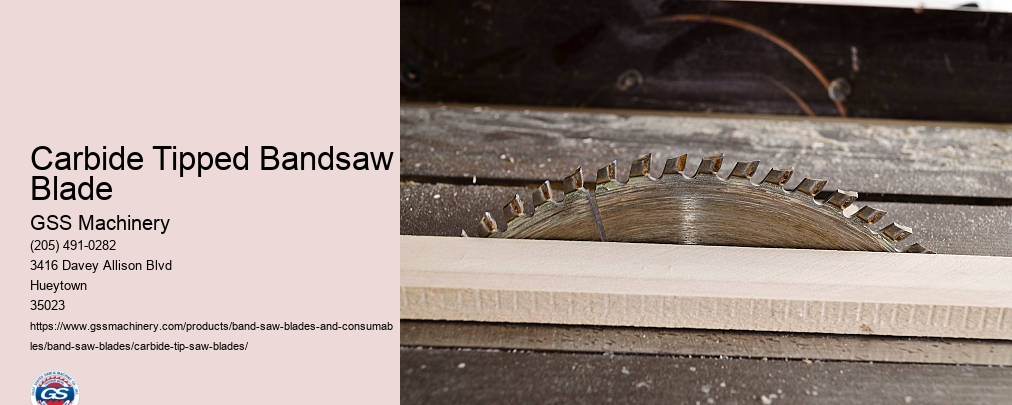
Precision is crucial in woodworking, and carbide-tipped blades can significantly enhance it.

Carbide-tipped blades are a cost-effective choice for professional woodworking. While they may have a higher initial cost compared to traditional steel blades, their long-term benefits outweigh the upfront investment. One of the primary reasons for their cost-effectiveness is their extended lifespan. Carbide-tipped blades last significantly longer than steel blades, reducing the frequency of replacements and associated costs. The ability to maintain sharpness for a longer period also contributes to cost savings. Fewer sharpenings mean less downtime and lower maintenance costs. This is particularly important in a professional setting where time is money. The durability of carbide-tipped blades also means fewer blade breakages. This reduces the need for frequent replacements and minimizes disruptions to workflow. The robust construction of these blades ensures they can handle heavy use and tough materials without wearing down quickly. The versatility of carbide-tipped blades further enhances their cost-effectiveness. These blades can handle a variety of cutting tasks, reducing the need for multiple blade types. This versatility means you can rely on a single blade for different applications, saving money on purchasing and storing multiple blades. In addition to the direct cost savings, carbide-tipped blades also improve productivity. Their ability to provide clean and precise cuts reduces the need for additional finishing work, saving time and effort. This increased efficiency translates to higher productivity and profitability in a professional woodworking setting. Overall, the cost-effectiveness of carbide-tipped blades in professional woodworking is evident. Their extended lifespan, sharpness retention, durability, versatility, and productivity benefits make them a valuable investment for any professional woodworker.
Safety is paramount when using carbide-tipped saw blades. One of the most important safety tips is to wear appropriate personal protective equipment (PPE). This includes safety glasses, hearing protection, and gloves. PPE helps protect you from flying debris, loud noises, and potential injuries. Ensure that the blade is properly installed and tensioned before use. A loose or improperly tensioned blade can lead to accidents and poor cutting performance. Refer to the manufacturer's guidelines for the correct installation and tensioning procedures. Always use a push stick or push block when cutting small or narrow pieces of material. This keeps your hands away from the blade and reduces the risk of injury. Never attempt to cut small pieces with your hands close to the blade. Heat resistance Keep the work area clean and free of clutter. A clean workspace reduces the risk of tripping or knocking over materials, which can lead to accidents. Use a dust collection system to keep the area free of dust and debris. Avoid wearing loose clothing or jewelry when operating the bandsaw. Loose items can get caught in the blade, leading to serious injuries. Tie back long hair and ensure that clothing is snug and secure. Always turn off the bandsaw and disconnect it from the power source before making any adjustments or changing the blade. This prevents accidental start-ups and ensures your safety while working on the machine. Regularly inspect the blade for damage or wear. A damaged blade can break during use, posing a serious safety risk. Replace any damaged or worn blades immediately to ensure safe operation. By following these safety tips, you can minimize the risk of accidents and injuries when using carbide-tipped saw blades. Prioritizing safety ensures a secure and efficient woodworking experience.
Carbide-tipped saw blades offer numerous advantages for woodworking. Their durability, sharpness retention, and heat resistance make them a valuable tool in any workshop. Proper maintenance and following best practices ensure optimal performance and longevity. Choosing the right blade for your bandsaw and understanding common issues can enhance your woodworking projects. The cost-effectiveness and precision of carbide-tipped blades make them a preferred choice for professionals. Prioritizing safety when using these blades is essential for a secure and efficient experience. By leveraging the benefits of carbide-tipped blades, you can elevate the quality and efficiency of your woodworking projects.
Discover the game-changing benefits of carbide-tipped bandsaw blades for woodworking and metalworking. Learn about their durability, precision, selection criteria, maintenance tips, and more to elevate your craft.
"Carbide-tipped bandsaw blades are a game-changer in the world of cutting tools. Known for their durability and precision, these blades are essential for anyone serious about woodworking or metalworking. They offer a significant upgrade over traditional steel blades, providing cleaner cuts and longer life. Whether you're a professional craftsman or a hobbyist, understanding the benefits and proper use of carbide-tipped bandsaw blades can elevate your work to the next level. This post will delve into the advantages, selection criteria, maintenance tips, and more, ensuring you get the most out of your investment.
Carbide-tipped bandsaw blades offer several key advantages. First, they are incredibly durable. The carbide tips are much harder than steel, allowing the blades to maintain their sharpness longer. This means fewer blade changes and less downtime. Second, these blades provide cleaner cuts. The sharpness and durability of carbide tips result in smoother finishes, reducing the need for additional sanding or finishing work. This is particularly beneficial for precision tasks where accuracy is crucial. Multi-purpose cutting Third, carbide-tipped blades are versatile. They can cut through a variety of materials, from hardwoods to metals, without losing their edge. This makes them a valuable tool for workshops that handle diverse projects. Finally, they are cost-effective in the long run. While the initial investment may be higher, the extended lifespan and reduced need for replacements make carbide-tipped blades a more economical choice over time.
Choosing the right bandsaw blade for your material is crucial for achieving optimal results.
Proper maintenance is key to extending the life of carbide-tipped bandsaw blades. Start by keeping the blade clean. Resin and pitch buildup can dull the blade and reduce its efficiency. Use a blade cleaner to remove any residue after each use. Regularly inspect the blade for any signs of wear or damage. Look for chipped or missing teeth, as these can affect the quality of your cuts. Replace the blade if you notice any significant damage. Proper tensioning is also crucial. A blade that is too loose can wander and produce inaccurate cuts, while one that is too tight can break. Follow the manufacturer's guidelines for the correct tension settings. Lubrication is another important aspect. Use a blade lubricant to reduce friction and heat buildup, which can extend the blade's life. Finally, store the blade properly when not in use. Keep it in a dry, cool place to prevent rust and corrosion.
Carbide-tipped blades and traditional steel blades each have their own set of advantages and disadvantages. Carbide-tipped blades are known for their durability. The carbide tips are much harder than steel, allowing them to maintain their sharpness longer. This results in fewer blade changes and less downtime. In terms of cutting performance, carbide-tipped blades provide cleaner cuts. The sharpness and durability of the carbide tips result in smoother finishes, reducing the need for additional sanding or finishing work. This is particularly beneficial for precision tasks where accuracy is crucial. However, carbide-tipped blades are more expensive upfront. The initial investment is higher compared to traditional steel blades. But, the extended lifespan and reduced need for replacements make them more cost-effective in the long run. Traditional steel blades, on the other hand, are less expensive and more readily available. They are suitable for general-purpose cutting but may require more frequent replacements. They are also easier to sharpen, making them a good choice for those who prefer to maintain their own tools.
Carbide-tipped bandsaw blades are used in a variety of industries due to their versatility and durability. In the woodworking industry, they are essential for cutting hardwoods and softwoods with precision. The clean cuts they provide reduce the need for additional finishing work, saving time and effort. In the metalworking industry, carbide-tipped blades are used to cut through various metals, including steel and aluminum. Their durability allows them to maintain their sharpness even when cutting through tough materials, making them a valuable tool for metal fabricators. The construction industry also benefits from carbide-tipped bandsaw blades. They are used to cut through materials like concrete and masonry, providing clean and precise cuts. This is particularly important for tasks that require a high level of accuracy. Finally, in the automotive industry, these blades are used to cut through various components, including metal and plastic parts. Their versatility and durability make them an essential tool for automotive manufacturers and repair shops.

Proper installation and tensioning of a carbide-tipped bandsaw blade are crucial for optimal performance. Start by ensuring the saw is unplugged to avoid any accidents. Remove the old blade carefully, following the manufacturer's instructions. Next, install the new carbide-tipped blade. Make sure the teeth are pointing in the right direction. Place the blade on the wheels and guide it through the blade guides. Ensure it is properly aligned and centered on the wheels. Once the blade is in place, adjust the tension. Follow the manufacturer's guidelines for the correct tension settings. A blade that is too loose can wander and produce inaccurate cuts, while one that is too tight can break. After tensioning the blade, adjust the blade guides. The guides should be close to the blade without touching it. This will help keep the blade stable during cutting. Finally, check the tracking. Turn the wheels by hand to ensure the blade is tracking properly. Make any necessary adjustments to keep the blade centered on the wheels.
Carbide-tipped bandsaw blades can encounter several common issues. One of the most frequent problems is blade drift. This occurs when the blade wanders off the cutting line. To fix this, check the blade tension and tracking. Ensure the blade is properly aligned and tensioned according to the manufacturer's guidelines. Another common issue is blade breakage. This can be caused by excessive tension, incorrect installation, or using the wrong blade for the material. To prevent breakage, follow the manufacturer's instructions for installation and tensioning. Use the appropriate blade for the material you are cutting. Blade dulling is another issue. Over time, the blade can lose its sharpness, resulting in rough cuts. To address this, clean the blade regularly to remove any buildup of resin or pitch. Replace the blade if it becomes too dull. Finally, overheating can be a problem. This can cause the blade to warp or lose its temper. To prevent overheating, use a blade lubricant to reduce friction and heat buildup. Carbide grit blades Ensure the blade is properly tensioned and aligned to minimize resistance during cutting.
Blade speed and feed rate are critical factors that impact cutting performance. Blade speed refers to how fast the blade moves, while feed rate is the speed at which the material is fed into the blade. Both need to be balanced for optimal results. High blade speed can result in cleaner cuts but may cause overheating. Overheating can dull the blade and reduce its lifespan. To avoid this, use a blade lubricant and ensure proper tensioning.
Carbide-tipped blade technology has seen several innovations in recent years. One of the most significant advancements is the development of advanced carbide formulations. These new formulations offer increased durability and wear resistance, extending the life of the blade. Another innovation is the use of precision grinding techniques. These techniques produce sharper, more consistent teeth, resulting in cleaner cuts and improved performance.
Safety is paramount when using carbide-tipped bandsaw blades. Start by wearing appropriate personal protective equipment (PPE). This includes safety glasses, hearing protection, and gloves. PPE helps protect you from flying debris, noise, and sharp edges. Ensure the saw is properly maintained. Regularly inspect the blade for any signs of wear or damage. Replace the blade if you notice any significant issues. A damaged blade can break during use, posing a serious safety risk. Follow the manufacturer's instructions for installation and tensioning. Improper installation or tensioning can cause the blade to wander or break, leading to accidents. Ensure the blade is properly aligned and tensioned before use. Use a blade guard to protect yourself from accidental contact with the blade. The guard should cover the blade as much as possible without interfering with the cutting process.
Carbide-tipped bandsaw blades offer numerous benefits, from durability to cleaner cuts. They are versatile and suitable for various materials and industries. Proper selection, installation, and maintenance are crucial for optimal performance. Carbide tooth design Innovations in technology continue to improve their efficiency and lifespan. Safety precautions are essential to prevent accidents and ensure a smooth cutting experience. By understanding these aspects, you can maximize the potential of carbide-tipped bandsaw blades and achieve superior results in your projects.
Yes, they are ideal for cutting various metals, including aluminum, steel, and non-ferrous metals.
These blades can cut through a variety of materials, including wood, metal, plastics, composites, and even some hard-to-cut materials like stainless steel and titanium.
Consider the material you are cutting, the thickness, and the desired finish. Look for a blade with the appropriate tooth configuration and pitch.


